























































Part 1 of 3
The Parker family has created a lasting imprint on the local sports community — not to mention polarized views — since purchasing the WHL’s Regina Pats in 1995. The Parkers’ stewardship underwent a profound change this summer when general manager Brent Parker stepped aside and replaced his father Russ as team president. With that in mind, Leader-Post hockey writer Greg Harder has prepared a three-part series on the Parker era.
TUESDAY: How it all began.
WEDNESDAY: The Parkers’ vision and its execution.
THURSDAY: The next chapter, under general manager Chad Lang.
REGINA — When the ‘For Sale’ sign was attached to the Regina Pats in 1995, they weren’t exactly in showroom condition.
Once a flagship franchise, the Pats were taking on water as they languished near the bottom of the WHL standings. That did not discourage Calgary-based entrepreneur Russ Parker, who dispatched his son Brent on a scouting mission to Regina during the first round of the 1994-95 playoffs.
“I remember asking a cabbie riding from the airport — they always seem to know everything that’s going on in town — and he didn’t even know there was a game going on that night,” recalls Brent Parker. “I came over to the box office to buy a ticket and got there really early thinking it’s a playoff game so it’s going to be full. I walked up and said to the lady, ‘I’m looking for a ticket to tonight’s game, what do you have available?’ I still remember her pushing the seating map across going, ‘Take your pick.’ I was shocked.”
When Parker walked on to the concourse of the Agridome (now Brandt Centre), his eyes confirmed what his ears had been unable to comprehend.
“There couldn’t have been a thousand people in the place,” he said.
As first impressions go, it wasn’t much to write home about. Little did Parker know, the situation was even more dire beneath the surface, with a season-ticket base of under 500 and a dysfunctional dressing room that was coming apart at the seams.
“It was rock bottom,” says Leader-Post columnist Rob Vanstone, who covered the Pats that season. “Some of the Pats’ players were so happy the season was over that it appeared they had won the Memorial Cup, as opposed to being swept. The second half of that season, in particular, was filled with turmoil. There was infighting at virtually every level, and that was borne out by the struggles on the ice. The Parkers were faced with having to rebuild the organization from the ground up, on and off the ice.”
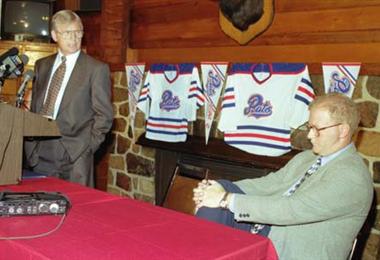
Russ Parker formally acquired the Pats on June 21, 1995, putting an end to a proverbial merry-go-round which saw the team change hands, not once, not twice, but three times in less than a month.
The previous owners — a group that included legendary GM Bill Hicke — had run the team for nearly 10 years when they sold it to the Ochapowace First Nation on June 9, 1995. On June 16, the WHL’s board of governors voted 16-1 to reject that deal and exercised its option to buy the franchise.
Two members of the previous ownership group — Ted Knight and Morley Gusway — responded by aligning themselves with Ochapowace and submitted an offer. But the league sided with Parker, accepting his bid of $1.7 million.
Of course, none of this was the first sign of instability for the Pats. Not by a longshot.
“People forget that the Pats had become virtually inconsequential before the Parkers took over the franchise,” notes former Leader-Post sports editor Gregg Drinnan, who now holds the same position with the Kamloops Daily News. “People forget that this franchise was on its way to Swift Current (in ’85-86), all over a $1 parking charge that was to be implemented (by the Regina Exhibition Association). At Christmas that year, the franchise was as good as gone; games were being rescheduled for Swift Current. The league intervened, bought the team and then sold it to a local group that included Bill Hicke, Ted Knight, Jack Nicolle and Morley Gusway. Those gentlemen had good intentions but they got in at precisely the wrong time. They were all businessmen but none of them were in the business of hockey. And the business of hockey, certainly in the WHL, was changing in a big, big way and the evolution was hitting high gear just as they began running the Pats.”
The Parkers had considerably more expertise in that regard with an ownership resume that included the Calgary Cannons AAA baseball team as well as the International Hockey League’s Kansas City Blades and the B.C. junior league’s Kelowna Spartans.
Russ Parker had originally hoped to build a new arena in Kelowna and lure a WHL team there, but the league instead handed the keys to Bruce Hamilton, approving the relocation of his Tacoma Rockets. As a result, the Parkers were forced to suspend operation of the Spartans, temporarily leaving them out in the cold.
“We didn’t like the decision but they did the right thing,” Brent Parker now admits. “Bruce was in trouble in Tacoma. You have to look after your partners first so they gave him the opportunity to move in there. It has obviously been a tremendous success.”
Soon after, WHL president Ed Chynoweth — a long-time friend of Russ Parker — made him aware of the situation in Regina. Russ, who grew up in Moosomin, had previously declined an opportunity to buy the Victoria Cougars, who moved to Prince George a year earlier, but he had a definite interest in the Pats.
The next logical move was to do some window shopping — hence Brent’s trip to Regina.
“You knew the history and the tradition of the franchise but it had obviously for whatever reason fallen on hard times,” says the junior Parker, who nonetheless wasn’t discouraged by what he saw. “It was more along the lines of, ‘We can do some good things here.’ It was maybe in need of a fresh coat of paint, some new thoughts and new ideas. You’re excited about what you think is a canvas you can create with. There was no question there was a lot of work to do. But we felt it was a good sports market and had an opportunity to grow and be better than it was at that time. It probably had only one direction to go.”
The slow climb began with a whirlwind summer for Brent Parker, who moved into his house in Regina about three days before the start of training camp. Once he was able to sink his teeth into the franchise, he quickly discovered a disturbing tone within the organization.
“It was almost defeatist,” he says. “There wasn’t a whole lot of progressive thinking. At that time, sports marketing was just getting big. We had done it in Calgary with the ball club. Canada at the time wasn’t a baseball hotbed. Everything we did was on family entertainment, getting the families to the ball park, promotions and giveaways and activities. We wanted to bring a bit of that here. We wanted people to enjoy coming to the building for the event as much as they did for the game.”
Meanwhile, the Pats also had to sell their fans on a general manager with no WHL experience. To some, the brash young GM was a breath of fresh air. To others, he was an outsider whose main qualification was being the owner’s son.
“You have to remember, it’s a family business,” Russ says. “We’ve had other family businesses and this was one. It’s a private company. We make decisions based on what we think is in the best interest for us. Brent had some experience in junior hockey with the team in Kelowna. It was something he wanted to do. He spent some time with us when we were in Kansas City to see how the operation evolved there. There was no doubt in my mind he was ready. At the time we tried to find somebody to maybe come in and work with him. We had a couple people in mind. It didn’t turn out so he rolled up his sleeves.”
Brent Parker had grown up in baseball, working his way from the bottom of the Cannons’ organization. He paid his dues polishing shoes, doing laundry and working on the grounds crew, eventually climbing the corporate ladder to become assistant general manager in charge of stadium operations.
“It was an awesome way to grow up,” says Parker. “You learned the value of hard work. You really did get an understanding of the hours that go into it and everybody’s different role that they play (within an organization).”
Parker applied what he learned to his first high-level hockey job as the president and GM of the junior A Spartans. He took over midway through the 1992-93 season, inheriting a team that — with the help of a couple key moves — went on to win a national championship. The next year, Parker and head coach Jim Hammett lost half their team but successfully rebuilt the squad it into a group that would make it back to the national final, losing in overtime after a player scored on his own net. In Parker’s final year at the helm, the Spartans made it back to the league championship, marking their third straight appearance in the final.
At the time, Brent Parker thought he was ready for the next level. In retrospect, nothing could have completely prepared him for the challenge that awaited in Regina.
“I threw myself in with both feet, I know that,” he says with a laugh. “But it was tremendously overwhelming at first. There were days when your head was spinning.”
The first challenge was to begin repairing a fractured and somewhat indifferent relationship between the team and its fans. That process began when they hired director of marketing Scott Clark, who was undaunted despite the skepticism he encountered on the street.
“Right off the hop Scottie Clark was outstanding,” says Parker. “He had a passion and a drive for the franchise. He was out in the community and started working better with the media, which was important to us. He was trying to find a radio deal. Scottie hit the ground running. Then we hired another sales guy. They were out knocking on doors. We found that a lot of people had never been talked to.”
The sales pitch wasn’t limited to fans.
Coming off a tumultuous season under former head coach Norm Johnston, Parker had to begin mending fences with the players. One of them was captain Dion Zukiwsky.
“He wasn’t coming back; there was no way,” recalls Parker. “I went to see him and it couldn’t have been worse timing. The day I got there, they had just found out like an hour earlier that his grandfather passed away. It was an incredibly awkward meeting but Dion came back and was a huge part as our captain that year of reviving the room.”
Other veteran players who were instrumental in that process included Rhett Gordon, Russ Hewson and Chad Mercier.
“There was quite a bit of controversy that followed the team (the previous year),” recalls Mercier. “We came back to new owners. To be honest, I was really nervous about it. But it was a real turnaround, on and off the ice. It was a fresh start for everybody. Everything they did, the professionalism really rose. We were out in the community more. They tried to get the alumni involved. One of the best moves they made was hiring Rich Preston as coach. He really brought us together. He treated us like men. He expected us to act that way but he treated us like professionals and it followed suit off the ice with the Parker family.”
Despite a sense of renewed optimism within the organization, the Pats were still projected to be a last-place team that season. They ended up third in the division (37-33-2) and swept the Lethbridge Hurricanes in the first round of the playoffs before losing in seven games to the Prince Albert Raiders.
“When we exceeded expectations that year, it really started something,” says Mercier. “The crowds went up, the atmosphere went up. What we saw as players from our facilities like weight rooms, all those sorts of things were drastically improved. What they were able to do was create that, ‘OK, we’ll do whatever we can to make this the best possible for you guys as players but we expect you guys to put forth the effort.’ We had some good players, but it’s probably the reason why we overachieved that year.”
Looking back, Brent Parker thinks one of his best moves was to simply encourage an open-door policy with his players. He wanted them to feel comfortable coming into his office, even if it was just for a visit.
Little did he know they’d take him so literally.
“One day I walk in and Zuk and Hewie were lying on the floor reading the paper and Rhett Gordon was on my couch reading another chunk and Merc was sitting in the chair,” Parker adds with a laugh. “I remember walking in and going, ‘Guys, I’m not sure this is exactly what I had in mind.’ That to this day is the team I probably enjoyed the most. They were such a lunch-bucket group that had a ton of fun together. They got in their share of trouble but they came to work every day at the rink and they busted their asses. That’s when I kind of knew we were going the right direction and I think we started seeing our fans enjoy that group. We averaged about 3,200 that year, which was about 700 or 800 more than the year before. A lot of things really fell into place that really helped us start the building blocks.”
By Greg Harder
Check back for Parts 2 and 3, or pick up a copy of the Leader-Post.