




























































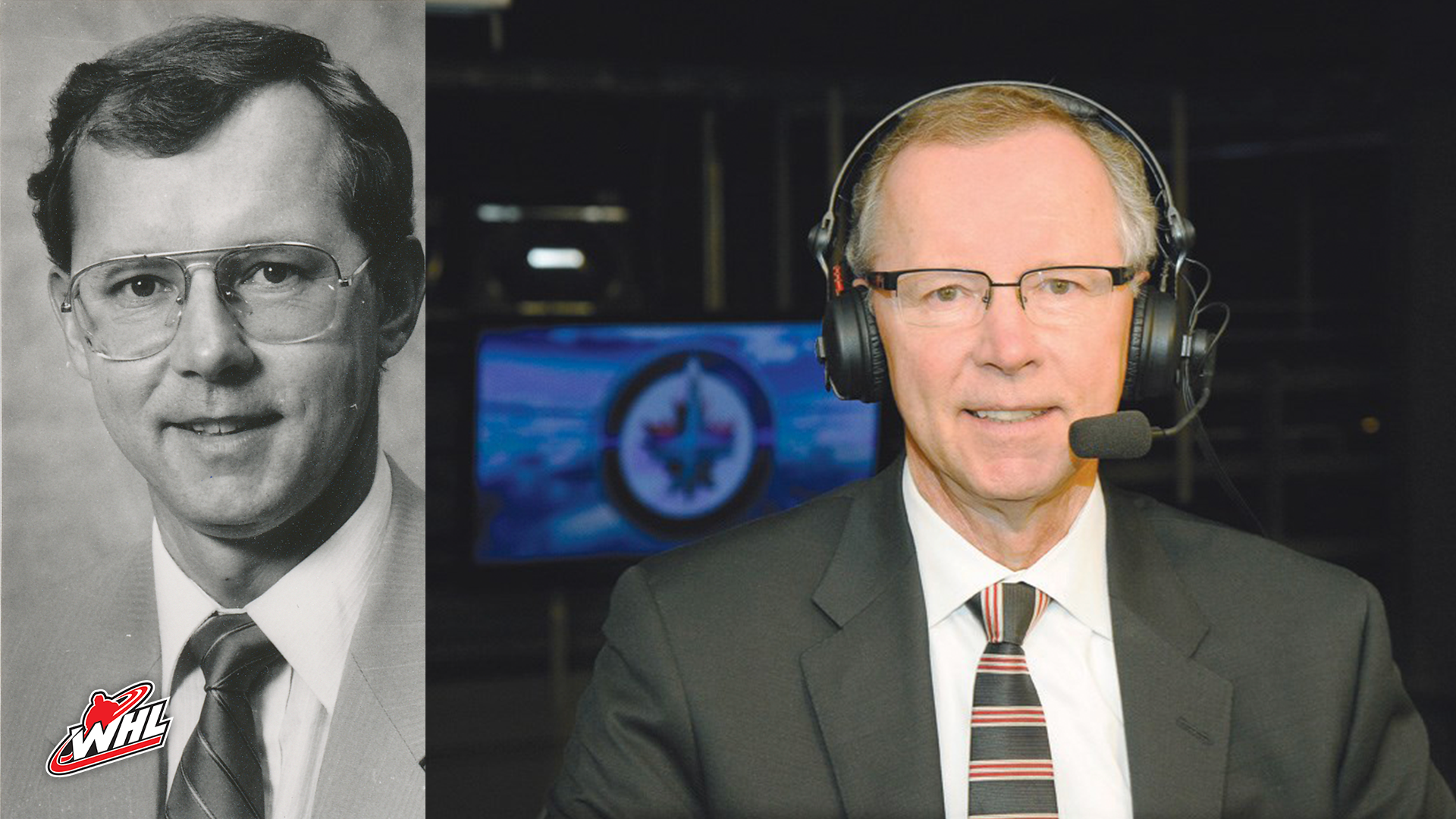
WHL alum Dennis Beyak reflects on more than 50 years of sports broadcasting
Dennis Beyak has pulled off the retirement hat trick.
After calling his final National Hockey League game between the Winnipeg Jets and Seattle Kraken in April of 2022, his closing IIHF World Championship Game in the spring of 2023 and his last IIHF World Junior Championship match earlier this year, the legendary Canadian broadcaster has truly hung up his headset.
But not without one final memorable moment, which has been viewed more than one million times on social media alone.
What a moment. Craig Button presents Dennis Beyak with a jersey in honour of his retirement ❤️#WorldJuniors pic.twitter.com/RUWImmYtkO
— TSN (@TSN_Sports) January 2, 2024
In his final broadcast, TSN analyst Craig Button presented Beyak with a Flin Flon Bombers jersey, representing the former WCHL team that Beyak got his start with back in 1970-71.
Bombers alum Duane Bray donated his jersey.
“We were doing okay until Craig became emotional,” Beyak said. “Then Laura Diakun was back (on the panel) at TSN and she and I had a little bit of a pact there- I won’t make you cry, you don’t make me cry.
I think it has (sunk in), but I’ve kind of done it in stages. Maybe that’s made it a little bit easier.”
Beyak has provided memorable calls over nearly three decades for the Winnipeg Jets, Toronto Maple Leafs and Edmonton Oilers.
But it all started in Flin Flon, Man., nearly 500 kilometres north of his hometown of Winnipegosis, where he called his first game when the normal voice of the WCHL’s Bombers, Bruce Keddie, was under the weather.
Fresh off of a one-year broadcasting course and with a crisp new contract with the CFAR radio station, Beyak was primed to live out his radio dream and learn some tough lessons along the way.
“When you go to school, when you have a goal, you never know if you’re going to get that first game and you never know what that first job is going to be,” Beyak explained. “The first job in Flin Flon… I mean, I was a kid, it was all new to me. It was it was a great atmosphere, the Flin Flon bombers back then just had this thing about them. When the Flin Flon Bombers came to town, look out. You knew that there were going to be extra people at the game, the game was going to have a little more intensity to it and everything that goes with that.”
In those early days before the WCHL would shorten its name to the WHL, there was just as much to contend with off the ice as on- particularly when it came to unique broadcasting setups across the league.
“The old New Westminster Queen’s Park Arena, the first couple of years they never really had a press box,” Beyak recalled. “Someone before the game would meet you there with a ladder, you go up into the organ loft, where there are two speakers, one on each side of you. That was your broadcast position. You had to deal with the speaker from the organ right beside you. I do remember one night unplugging the wires. Then you hope like heck that somebody at the end of the game was going to come down with a ladder and let you come back down again.”
It seems everyone liked Beyak too much to leave him stranded high above the crowd.
He built connections with people like four-time WHL Coach of the Year Pat Ginnell, who convinced Beyak to join him on the West Coast with the Victoria Cougars for several seasons before Beyak switched it up and joined the Saskatoon Blades not as a broadcaster, but as Director of Player Relations and Assistant General Manager.
His tenure included chairing the 1989 Memorial Cup, which saw the Blades make it to the title match before being bested by the Swift Current Broncos, winning the WHL’s Executive of the Year award the same season and being coerced back into the broadcast booth by eager fans.
When SaskTel Place opened in February of 1988, local TV station Telecable was eager to broadcast the Blades’ first game in their new digs.
That’s when General Manager Daryl Lubiniecki put on his agent hat.
“Telecable wants to do the game and Daryl Lubiniecki says you can do it, but Dennis has to call the game and you have to pay him $500,” Byeak laughed. “At that point in time, that was pretty good. I think the team got $500 from Telecable too. It may be the first-ever broadcast rights fee in the Western Hockey League. The owner of the team, Nate Brodsky, called me in one day and said, ‘Geez, I’m getting calls from people saying we need to get you back in the broadcast booth full time’. So then I stayed working for the team, but I also did the broadcast.”
The wildly successful 1989 Memorial Cup primed Beyak for a jump to the Seattle Thunderbirds as Assistant General Manager as the team prepared to host the 1992 edition of the tournament- the third time the event would be held in the United States.
His work would earn him the General Manager title in Seattle from 1992-1994 and, later, in Tri-City from 1994-95, carrying with him a favourite saying of Lubiniecki’s from Saskatoon.
“He was the one that said, ‘Don’t do anything after a game, don’t do anything when you’re mad. The sun will come up tomorrow morning’. It doesn’t matter whether you lose, win, whatever, the sun will come up the next morning. That was key because we all get emotional after games. We want to win every game but that’s not going to happen.”
Tri-City would prove to be Beyak’s final destination in the WHL, which had grown from 10 teams to 16 over his tenure, before snagging a coveted deal to call games for the Edmonton Oilers.
He’s continued to keep a foot in junior hockey over the years through TSN’s broadcasts of the IIHF World Junior Championship, culminating in one last match between the United States and Latvia on January 2, 2024.
Now, he’s enjoying retirement with his wife of more than 40 years, Bev, splitting their time between Arizona and their home in Kelowna, B.C.
In a way, it’s fitting that it began and ended with a junior hockey game.
“I loved every minute of the league,” Beyak said. “The Western Hockey League is a special place. Junior Hockey is a special league. The players that come through junior hockey become men. It’s special for them as well, but it’ll certainly be special for me and the (legendary Medicine Hat Tigers broadcaster) Bob Ridleys and all the other you know, the Gregg Drinnans who spent so much time covering the Western Hockey League. I think even for us who have retired or moved on, the league will still always be special for us.”











 Loading ...