






























































Celebrating Black History Month: Willie O’Ree
Throughout Black History Month, the Petes will recognize and highlight key members of the Black hockey community and showcase their illustrious careers and positive, long-term impact on the game.
Willie O’Ree was born on October 15th, 1935 and raised in a large family in Fredericton, New Brunswick where he was the youngest of his mother Rosebud and father Harry’s 13 children. O’Ree’s earliest hockey memories came on the outdoor rink, where he learned to skate at age three. He began playing organized hockey at five-years-old.
O’Ree quickly became a young hockey star in New Brunswick. At 14-years-old, O’Ree suited up for the Fredericton Falcons in the New Brunswick Amateur Hockey Association. He would reach the senior league to join the Fredericton Capitals for the 1953-54 season.
O’Ree played for the Kitchener Canucks during his first year in the Ontario Hockey Association, where he experienced a career threatening injury. O’Ree’s right eye was struck by a puck so hard that he lost 95 percent of vision in the eye. He refused to give up. The future role-model stayed off the ice for two months and did not tell anyone how bad it was because the NHL forbade players who were blind from playing.
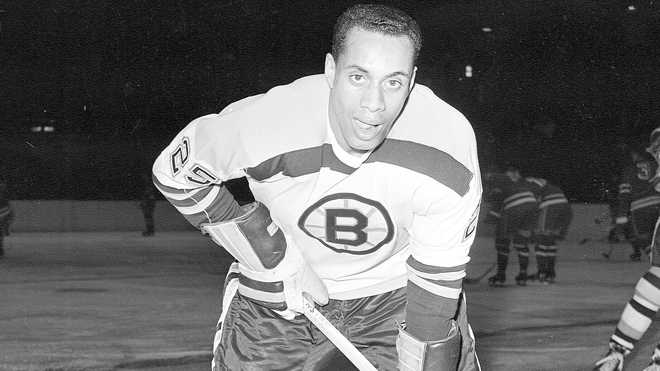
After a year in Kingston, the Fredericton native moved to Quebec as a member of the Quebec Aces in the Quebec Hockey League. The move would change O’Ree’s career as the Aces and Boston Bruins formed an affiliation in O’Ree’s second season. On Jan. 18, 1958, O’Ree received a call-up from the Bruins, becoming the first black player to play a game in the National Hockey League. After appearing in two games in the 1957-58 season, O’Ree returned to Boston during the 1960-61 season in a more consistent role.
On Jan. 1, 1961, O’Ree made history by becoming the first black player to score an NHL goal in a 3-2 Bruins win over the Montreal Canadiens.
O’Ree, focused and enjoyed by his teammates, experienced racial abuse several times throughout his career from opposing players and fans. He kept forging his path ahead undeterred by the insults of others. He changed the game of hockey when he played and continued to inspire even after he stepped off the ice.
The NHL recognized his contributions and named him the Director of Youth Development in 1998. O’Ree travelled across North America, talking with young hockey players and fans to grow the game as well as the communities he visited. He became the first black player to be inducted into the NHL Hall of Fame in 2018.
On January 18, 2022, the Bruins raised his number 22 into the rafters while O’Ree and his family watched from their home. There, his name and number hangs forever.