




























































Five new members will be inducted into the QMJHL Hall of Fame
BOUCHERVILLE, Monday December 15, 2014 – The commissioner of the Quebec Major Junior Hockey League, Gilles Courteau, unveiled today, the names of the five new inductees that will make their way into the QMJHL Hall of Fame on Wednesday April 8, 2015 at the Hyatt Regency Hotel in downtown Montreal.
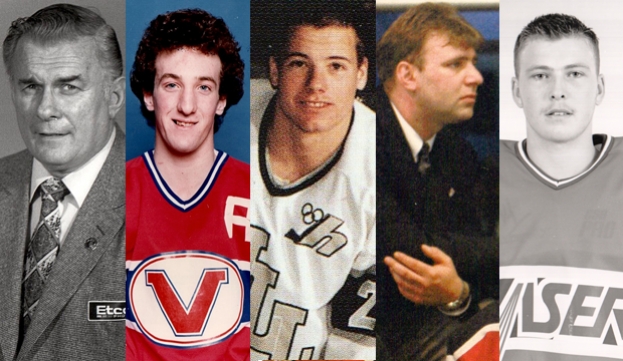
Three players and two builders will be honoured. “We will recognize five important figures in our history during the evening” said the commissioner. “We will have the pleasure of celebrating the careers of Martin Brodeur, Billy Campbell, Martin Gélinas and Michel Therrien. Moreover, to mark the 20th anniversary of the QMJHL Hall of Fame, we will posthumously honour for the first time in our history, Jean Rougeau, one of our builders. I would like to thank the members of the QMJHL Hall of Fame, selection committee: Michel Côté (president), Denis Baillargé, Michel Gagnon, Bertrand Raymond and Marc Lachapelle for their excellent and continuous contribution to this precious institution.”
The president of the selection committee, Michel Côté, also added: “There are so many worthy candidates, that choosing is always very difficult. However, we rigorously analysed each candidate and believe that we have made the right choices. All five individuals had excellent careers in the Quebec Major Junior Hockey League and fully deserve this honour. We are looking forward to inducting them into the Hall of Fame.”
Here is a brief overview of their careers:
It was with nothing but class and his trademark good nature that Martin Brodeur carried himself during both his junior and professional hockey careers. Over the years, the goalie would prove be the ultimate example of loyalty towards his teams. A native Montrealer, Brodeur was a winner in every sense of the word. He would go on to amass countless individual and team honours all while rewriting the record books along the way.
Over his three seasons in the QMJHL, he played in 163 games with St. Hyacinthe including the playoffs, winning 79 games. His goals against average (3.56) and save percentage (.886) were solid numbers in the league at that time. He would make his mark as of his first season in the QMJHL, earning a spot on the league’s All-Rookie Team in 1990.
After catching the eye of NHL scouts, Brodeur would be selected by the New Jersey Devils in the opening round of the 1990 NHL Draft. Late in the 1991-92 season, he was called up on an emergency basis due to injuries to the Devils’ regular goalies Craig Billington and Chris Terreri. On March 26, 1992, Brodeur would play his first NHL game which also proved to be the night he notched his first career victory with a win over the Boston Bruins. Soon after, he was informed by the Devils that he would be ending the season with the team. That proved to consequently be a tough blow for the Laser who would lose their No. 1 goalie for the balance of the season.
But after playing in four games at the NHL level and having missed the opening playoff game of his junior team, Brodeur in a strange twist of fate would return to St. Hyacinthe under peculiar circumstances. On the afternoon of April 1, 1992 a strike was declared in the NHL and a private jet whisked the young star to the St. Hubert airport where the small four-seater plane would land at 6:20 p.m. His race to the arena would be completed by car as he would arrive at St. Hyacinthe’s Stade LP-Gaucher for an abbreviated nine-minute warm-up much to the delight of his teammates, head coach Pierre Petroni and Laser fans alike. Brodeur would go on to make 30 saves in a 6-2 win to tie the series at 1-1. Despite his brilliant play in the rest of the series (2.65 | .930) the Laser was ultimately ousted in six games by the Verdun College Français – the eventual President’s Cup champs that year.
Over his 20 seasons in the NHL, the Devils’ famous No. 30 would intimidate the opposition with his prowess in the crease and his acrobatic saves. He also handled the puck like no other goalie in history and often sparked the Devils’ attack with his long and accurate passes. He would also be credited three goals over his career, including two scored in spectacular fashion by launching the puck the length of the ice.
After having one AHL season under his belt, he would go on to win the Calder Trophy with the Devils in 1993-94 as the NHL’s top rookie. Then in his second NHL campaign, he would help lead the Devils to the Stanley Cup, a team achievement he would savour two more times with New Jersey in 2000 and 2003. He would go on win the Vezina Trophy as the league’s top goalie a total of four times and be named to the NHL All-Star team seven times including on the first-team on three occasions.
He would go on to break numerous NHL records including several belonging to his boyhood idol, Patrick Roy such as most career wins (688) and most regular season games played (1,259). He also shattered Terry Sawchuk’s long-standing record of 103 shutouts by notching 124 of his own. Over the course of his brilliant career, Brodeur would post a spectacular goals against average of 2.24 and stellar .912 save percentage. All told, Brodeur was in a class of his own!
He also was a part of the Canadian Olympic team on four occasions, leading Canada to gold in 2002 and 2010.
After following in his father Denis’ footsteps by becoming a goalie like him, Martin’s own son Anthony has as well, debuting with the QMJHL’s Hull Olympiques in 2013.
Martin Brodeur will be inducted into the QMJHL Hall of Fame in the “player” category on April 8, 2015.
For four seasons in the early 1980s, defenceman Billy Campbell hardly went unnoticed, becoming one of the top QMJHL record-breakers in league history.
His main role on the ice may have been to protect the defensive zone, first for the Montreal Junior and then the Verdun Junior, but this No. 4 loved to chip in on the offensive end. His numbers proved to be electrifying: 353 points in 309 games in the regular season and playoffs combined!
Expectations were high for the Junior’s top pick. As soon as he first hit the ice in September 1980, he showed his true colours. He exploded for 18 points and four goals in his first 10 games en route to a 68-point campaign which would see him named the league’s top rookie blue-liner. To this day, no other 16-year-old defenceman has ever matched that point total as a QMJHL rookie.
In 1982-83, he would join forces with fellow offensive juggernauts Pat Lafontaine, Jean-Maurice Cool and Gerard Gallant in a season that saw Campbell explode for 35 goals and 99 points! Ironically, that would prove to be the only season he would fail to be named on the First or Second All-Star Team, being edged out by Jean-Jacques Daigneault and Michel Petit.
In May 1983, the Verdun Junior would raise the President’s Cup as QMJHL champions.
In 1983-84, he would lay claim to some of the league’s most prestigious records while being named the QMJHL’s top defenceman that season after posting his second-straight 90-plus point campaign.
By the end of his glorious career he scored 100 goals during the regular season, becoming the only QMJHL rearguard to achieve that feat. Campbell also cracked the 20-goal mark in each of his seasons in junior.
The night he scored his 100th career goal on March 7, 1984 against the Trois-Rivieres Draveurs, Campbell scored twice and added five assists in an 11-7 win. That seven-point performance was his career-best and also tied the league record for points in a single game on the road by a defenceman, a mark he still shares with Pierre Lacroix and Michel Leblanc.
On that same historic night, he also became the QMJHL’s all-time leader for points by a defenceman, shattering the previous mark of 318 points held by Pierre Sévigny. Campbell’s (played for 4 years) final career total of 321 points would stand as a league record for 18 years before being surpassed by Danny Groulx (played for 5 years) of the Victoriaville Tigres (332) in 2002.
Even though he went on to be a third round pick of the Philadelphia Flyers in 1982, Campbell never ended up playing a game in the NHL. After a 13-year career at the minor pro level in North America and in Europe, he would finally hang up his skates for good in 1996-97.
Billy Campbell will be inducted into the QMJHL Hall of Fame in the “Player” category on April 8, 2015.
As a 16 year old he got to represent Canada in Germany in the Junior Championships.
Renowned as a speedster, Martin Gelinas didn’t spend much time in the QMJHL, but he sure made the most of his time there.
Over his two seasons with the Hull Olympiques, the first-round pick piled up 208 regular-season points and added another 42 in the playoffs for an eye-popping total of 250 points in only 132 games of his QMJHL career. Gelinas also notched 10 hat-tricks along the way.
In his rookie QMJHL season in 1987-88, he was quickly shown all the confidence in the world by his head coach Alain Vigneault. He would go on average two points per game with 131 points and 63 goals. That breakout performance earned him the league’s Michel Bergeron Trophy as the QMJHL’s top offensive rookie while also being named on the league’s First All-Star Team at left wing. Gelinas’ accolades didn’t end there as he was also named CHL Rookie of the Year ahead of Rick Corriveau (OHL) and Stu Barnes (WHL).
During the 1988 QMJHL playoffs, the Olympiques would go on to claim the President’s Cup and the 17-year-old Shawinigan native would sure do his part in an offence primarily led by Marc Saumier. Gelinas would end that playoff march as his team’s second-leading scorer with 33 points on the strength of 15 goals and 18 assists. Several days later at the Memorial Cup, he would post four points in as many games and was named the event’s Most Sportsmanlike Player as the Olympiques bowed out in the semi-finals.
At the 1988 NHL Draft, he was the first round pick of the Los Angeles Kings. However only a few weeks later, the Kings would include him in the package of players they sent to Edmonton Oilers in the blockbuster trade that brought the game’s greatest player Wayne Gretzky to L.A.
As soon as the fall of 1988, the defending Stanley Cup champions Oilers already made room for an 18-year-old Gelinas who played in six NHL games before being returned to the junior ranks where he scored 38 goals and 77 points in only 41 games. That season he also donned his nation’s colours at the 1989 World Junior Hockey Championships where he helped lead Canada to a fourth-place finish.
At age 19, he made the jump to the NHL for good, launching a long career that would span from 1989-90 to 2007-08. He would go on to play in 1,273 games over that time, scoring a combined 309 goals and 660 points across seven different teams including four stops in Canada (Edmonton, Quebec, Vancouver and Calgary).
In May 1990, he capped his first full season in Edmonton by playing with the likes of Messier, Anderson, Kurri and Lowe, seeing his name engraved onto the Stanley Cup following the Oilers triumph over the Bruins in the Cup Final. That would prove to be the only time he would win hockey’s ultimate prize, but he did return to the Stanley Cup Finals on three other occasions: with Vancouver in 1994, Carolina in 2002 and Calgary in 2004.
Since 2012, Gelinas has been an assistant coach with the Calgary Flames.
Martin Gelinas will be inducted into the QMJHL Hall of Fame in the “Player” category on April 8, 2015.
Before becoming an accomplished coach, Michel Therrien was a QMJHL defenceman in the 1980s. In 1982-83, he would give it his all while with the upstart Longueuil Chevaliers, an expansion team coached by Jacques Lemaire that would come up just short in the finals against Verdun that year. Therrien then spent four years at the minor pro level before reorienting his career while staying in the hockey world.
It was with the Laval Titan under the guidance of the Morrissette family that Therrien would make his return to the QMJHL as an assistant coach from 1990 to 1993 under head coaches Claude Therien and Bob Hartley. From his very beginnings as a coach, he diligently learned the ropes from passionate role models who had a singular motivation – winning!
After winning the President’s Cup as an assistant coach with Laval in 1993, he would then be named head coach of the Titan, the team he would lead to two consecutive regular season titles. In the playoffs, he guided the Titan to a pair of league final appearances. Following his second year as head coach, he was earned QMJHL Coach of the Year honours.
During that period in 1994-95, the Morrissette brothers Jean-Claude and Georges sold their stake in the Titan. They then became owners of the Granby Bisons. They would transform that organization from top to bottom in the summer of 1995, making numerous trades and bringing a new leader on board: Michel Therrien. The talented club was then renamed the Predateurs and showed great character which no prey could measure up to.
Therrien’s team would win 56 games in 1995-96, claiming the regular season crown with 114 points only eight shy of the league record of 122 points held by the Trois-Rivieres Draveurs. The Predateurs would go on to eliminate Beauport in the league final as Therrien won his second President’s Cup title, his first as a head coach.
The Predateurs weren’t done there with the ultimate honour occurring on May 19, 1996. After a 4-0 win over the Peterborough Petes in the national final, team captain Francis Bouillon would skate up to claim the Memorial Cup and raise it high above his head. In doing so, the Predateurs became the first Quebec team to win the championship since the Quebec Remparts 25 years earlier in 1971. A great sense of pride was felt by the entire Granby Predateurs family. A new era was underway as QMJHL teams would no longer have any complexes towards their rivals in out West and in Ontario.
At the QMJHL level, Michel Therrien amassed 221 wins in 322 games. His impressive QMJHL career winning percentage of .707 is third all-time behind Gerard Gallant (.791) and Maurice Fillion (.733).
Since 1997 through to his induction, he would have spent nine seasons with the Montreal Canadiens organization at the AHL and NHL levels combined. He would have two stints behind the Habs’ bench, interspersed by his time as head coach of the Pittsburgh Penguins which included a trip to the Stanley Cup Final in 2008. Therrien counts over 1,000 games coached behind a pro bench.
Michel Therrien will be inducted to the QMJHL Hall of Fame in the “Builder” category on April 8, 2015.
JEAN ROUGEAU – posthumously –
In the QMJHL
Jean Rougeau was an important figure over the course of the QMJHL’s first 14 years of existence in a variety of roles. His charisma was unmatched much like his presence and notoriety gained from his time in the world of professional wrestling.
From the league’s inception in 1969, his involvement began to be felt. He helped bring the Rosemont National to the QMJHL and was a league governor during that historic inaugural season.
Just prior to the 1971-72 season, Rougeau made the important decision to transfer the franchise from Rosemont to Laval. He even moved behind the bench of the National as head coach for 104 games from 1971-72 to 1972-73. He was then the team’s GM from 1975 through 1978 also serving as governor of the Laval club from 1976 to 1978.
On August 8, 1981, he was elected president of the QMJHL, succeeding Marcel Robert. Nine teams made up the league at that time.
Jean Rougeau was determined to clean up the QMJHL’s image for all matters concerning the academic success of players. He hired the league’s first academic director, Jean Trottier. His intention was to cut down the dropout rate, increase academic bursaries for players both during their junior careers and after their junior days were over.
Shortly after his ascent to the presidency, heart-breaking news broke about Rougeau having cancer. Even once weakened by his illness, he courageously carried on with his functions right up until his resignation just days before he passed away in May 1983.
In honour of his memory at the start of the 1983-84 season, the Governors Trophy awarded to the QMJHL’s regular season champions would be renamed the Jean-Rougeau Trophy from that day forward.
Jean Rougeau will be posthumously inducted into the QMJHL Hall of Fame in the “Builder” category on April 8, 2015.
Professional Career
Before getting involved in the hockey world, Jean Rougeau was a renowned wrestler. For three decades, the 6-foot-2, 225-pounder tangled with opponents in the ring. After eight years in the amateur ranks, “Johnny” as he was known back then made the leap to the pros in 1951. His brother Jacques and his nephews Raymond, Jacques Jr. and Armand also made their mark in the squared circle. He would then form All-Star Wrestling in 1967.
Even as a teenager Jean showed signs of being an organizer, putting together wrestling galas in vacant lots. At the end of these shows, fans would throw money into the ring to compensate the wrestlers!
This accomplished business man also dabbled in politics, even serving as a bodyguard for future Quebec Premier, Rene Levesque in 1976.
Along with his wife Jacqueline, he raised two daughters Louise and Suzanne.