






























































DEVASTATING KNEE INJURY CHANGED KEHLER’S LIFE PATH
(Courtesy of Perry Bergson, The Brandon Sun) — J.D. Kehler’s life changed on Dec. 30, 1998.
Now 37, the former Brandon Wheat Kings centre said his head coach would have loved the way the play developed.
“It was a picture perfect play,” Kehler said. “I don’t think Bob Lowes could have drawn it better. I remember this vividly. We had a faceoff in our zone on the left-hand side. (Jamie) Hodson was in goal. I won the draw and the D went D to D and peeled it out to the winger over on the far boards. I got the puck and chipped it so that it was basically a one-on-one heading down the right side of the ice.
“I chipped the puck between the defenceman’s legs as he transitioned and cut in on him because I had him beat and he stuck his leg out. He hit me knee on knee.”
Now a father of two living in his hometown of Edson, Alta., and an executive with an oil company, his life path would lead in a completely different direction than he might have one day imagined.
His hockey journey began in Edson. He started skating at age six after his stepfather Sid built the family a little outdoor rink at their house on what at the time was a hobby farm. (It has since expanded into a bigger operation.)
His younger brother Joff, who would go on to play with the Spokane Chiefs for five seasons, was four at the time.
“We were at the rink guaranteed a minimum of two and probably more like four or five days a week,” Kehler said of his stepfather and mother Glenda. “They were definitely on board with making it happen … It was a huge commitment on their part, both in time and financially.”
J.D. played his minor hockey in Edson, but since AAA programs weren’t offered locally, both Kehler boys had to leave home at age 15 to play at a higher level.
After playing a year of AA bantam in Edson in 1995-96, he was chosen in the 1996 WHL draft by Brandon in the seventh round. He found out when he received a call from the team.
“We didn’t know anything about it,” said Kehler, whose older siblings were sisters. “There was no exposure to hockey in our family prior to that. We were very, very green to the situation and new to it. It wasn’t like we were sitting around the house waiting for the phone to ring. I think it completely caught us off-guard that I was selected in it. It was exciting as a result.”
He had never attended a WHL game.
Kehler moved to Spruce Grove, Alta., to join the AAA Broncos for his second season of bantam, putting up 36 goals and 42 assists in 35 games. He had another fine season as a 16-year-old rookie in midget AAA with the St. Albert Raiders, scoring 26 times and adding 26 assists in 32 games.
He also made his Wheat King debut that season, joining the team in Edmonton for a game against the Ice on Nov. 27, 1997.
“They were short and I was able to play in that game,” Kehler said. “That was exciting.”
He said his parents and others made the two-hour drive from Edson to see the game.
He would make the Wheat Kings as a 17-year-old for the 1998-99 season, joining a dressing room that included Jomar Cruz, Jamie Hodson, Randy Ponte, Andre Lupandin, Ryan Craig, Burke Henry, Dan Tetrault and others.
“It was a really good group,” Kehler said.
Because he had spent two years away from home already, Kehler found the transition wasn’t as bad as it was for some players. But it was still a remarkable amount of change for the young Albertan.
“I don’t know if you think about it,” he chuckled. “I think moving out of Alberta was probably the biggest thing.”
He noted that his goal was to make the Wheat Kings as a 16-year-old, and when it didn’t happen, he moved to a new team with new teammates in a new town with new billets and attended a new school in St. Albert.
“When you go to Brandon, really it’s your third year of doing the same thing,” Kehler said. “Now you’re in another province. I think the distance was the biggest factor. The rest of it was routine, if that makes sense.”
On the ice, Kehler quickly displayed an impressive two-way game and the ability to win in the faceoff circle, both unusual attributes in young players.
The reason why he displayed such fine defensive awareness makes the second talent far more unlikely.
“I was drafted as a defenceman and I chose to go forward the next year in AAA bantam because I didn’t want to play defence,” Kehler said. “I transitioned to forward after the bantam draft.”
He said he never worked with anybody in the faceoff circle, and when other minor hockey coaches now ask him to help their players with that skill, he’s willing but finds it hard to share his approach.
“When you did it, you just did it,” Kehler said. “You didn’t spend a bunch of time thinking about the mechanics of what you were doing. You looked at the other guy, watched how he lined up, and figured out whether you were going backwards or forward with your stick and where you were going to be placing your body. You read the other guy, and I don’t know how to teach that.”
He was 26 games into the season, with three goals and an assist, when it all came to an end in Red Deer.
Kehler had a pile of family and friends at the game, and after the knee-on-knee hit, was determined to simply skate it off. He made his way to the bench, and was soon sent back out for a draw in his own end.
“It hurt,” Kehler said. “I could feel it swelling and growing. I lined up for the draw and I believe I won the faceoff and turned to skate and fell down. I got back up and I fell down.”
He went back to the bench and told trainer Russ Holden that something was wrong with his left knee, and the doctor was brought down to the dressing room.
“It was like he grabbed a piece of spaghetti that had been boiled on the stove,” Kehler said. “My leg was like a wet noodle. It went every which way and there was no resistance. That was the end of it. It was the first game that my whole family had made it to watch me play.”
He saw a few doctors through the Wheat Kings organization and then returned home. In Alberta, his parents got him in to see Dr. Randy Gregg, the former National Hockey League player, who sent him to a surgeon in Edmonton.
The news couldn’t have worse, once it was finally diagnosed. He had a complete rupture of his posterior cruciate ligament (PCL), a tear of his anterior cruciate ligament (ACL) and meniscus damage.
“PCLs were not common,” Kehler said. “The only guy in the NHL who had something similar was Steve Yzerman, and his wasn’t a complete rupture. They just couldn’t fix it.”
One surgeon told Kehler that the window of recovery was a year, and the improvement would be between zero and 15 per cent.
The family decided against the surgery, and Kehler underwent scopes to clean the meniscus. He started rehab.
“It was devastating,” Kehler said. “You don’t deal with it at the time, because at the time it’s not going to affect you, right? It goes from OK, I’ve hurt my knee — we’ve all lost teeth or had a black eye or broken bone — and it’s going to heal and we’re going to go back. As it progresses, more and more it’s the reality of what’s going on.”
At Wheat Kings camp the next fall, he was doing strength training and the knee failed again. All the rehab he had done in the last nine months was suddenly in doubt. They went back to the drawing board and he started over in rehab.
He finally made his season debut on Oct. 29, 1999, 303 days after the initial injury. He could only skate every second day with a knee brace.
“There was hope that you were going to get it back and go,” Kehler said.
He played 24 games as an 18-year-old. On Jan. 2, 2000, he had a career high goal and an assist in Medicine Hat against the Tigers.
Kehler had to shut it down for the season after that night, and wouldn’t return again until Dec. 1 in his 19-year-old year. He would play 27 games in 2000-01, and said there wasn’t much to talk about in the year-end meeting with Wheat Kings brass because an overage season wasn’t in the cards for either side.
Kehler was resigned to his junior hockey career ending, and relieved in a way to end the stress of the situation.
His career statistics — nine goals and nine assists in 78 regular season games — belie the promise he showed as a rookie prior to the injury. But he completely understood the seriousness of the situation.
When he was 19, he saw the surgeon for the National Hockey League’s Edmonton Oilers.
“He was blunt with me but very polite,” Kehler said. “He said: ‘The only guy I’m aware of who has this is Steve Yzerman and his is a tear, not a complete rupture, and you walked in here with your mom. Tell me whatever you want me to do and I’ll do it, but if you continue to push it, you’ll probably have your mom push you in on a wheelchair the next time you come to see me.’
“That was when reality set in. You’ve had all this hope, and even though it’s failed you through these phases, you still have hope you’re going to get it back because you’re still dreaming of a career in hockey and get a chance to go on and make that next level.
“It was at 19 that reality hits, and it’s over. It’s hard because you’ve dedicated your life to it.”
With hockey at an end, Kehler had to make some hard decisions as a teenager.
He went home and got a job in the pipeline industry. He played a tiny bit of senior hockey, and then left the game for a decade until he began to play recreationally.
Kehler has had a steady progression in his career in the oil industry, and was a manager by the time he was in his mid-twenties. He is now vice-president of the company he helped co-found in 2012.
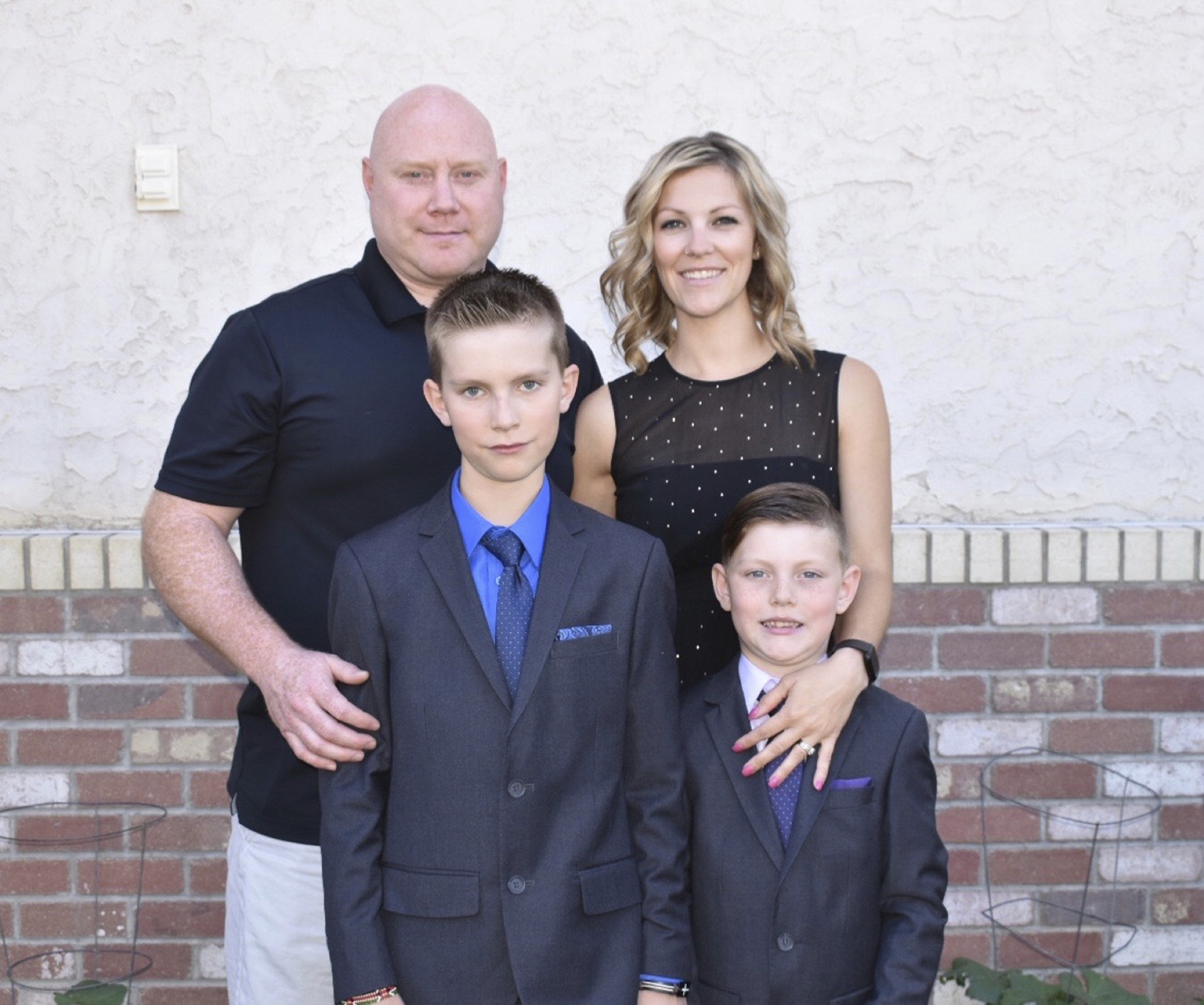
He and his wife Samantha have two boys, Kaleb, who is 12, and Brock, 8. They live in Edson, where Kehler serves as president of the local minor hockey association, and as an assistant coach with Kaleb’s peewee team and head coach for Brock’s novice squad.
He said it’s important that his kids pick up some of what he did.
“The good thing about sport is you learn about adversity, and sport helps overcome it,” Kehler said. “Even with my own kids, I love that they play hockey. I don’t have goals or targets for them because I think I would be setting them up to fail because I want them to play junior hockey. I just want them to go out and learn the life lessons about winning and losing and bearing down and hard work.
“As tough as it was, sport still helped me recover and move on as a person, even if it wasn’t doing what I wanted to do all my life.”
His left knee is pretty good now. He chuckles that he won’t be training for a marathon but can play road hockey with them or go snowmobiling.
“You live knowing what your limits are,” Kehler said, adding that he has to watch how hard he pushes himself. “Has it stopped me from doing anything with my kids or family? Not at all.”
So does Kehler regret his time in Brandon after what he ultimately went through, or does he look back at it fondly?
He doesn’t hesitate.
“It’s easy to focus on the negative, but I think you have to focus on the positive and take the positive away from it,” Kehler said. “For me, that’s what it was. I met a lot of great people. I was very fortunate that the game exposed me to some awesome people, be it billets, coaches or players, who were just great human beings.
“It taught me a lot about life, which has helped me out with where I am today.”
Kehler’s former team meanwhile scored a 6-5 overtime victory over Saskatoon on Saturday night and won’t play again until December 27th when they kick off a home and home series with the visiting Regina Pats.