




























































ALUMNI SPOTLIGHT: RAY BROWNLEE – AN ORIGINAL
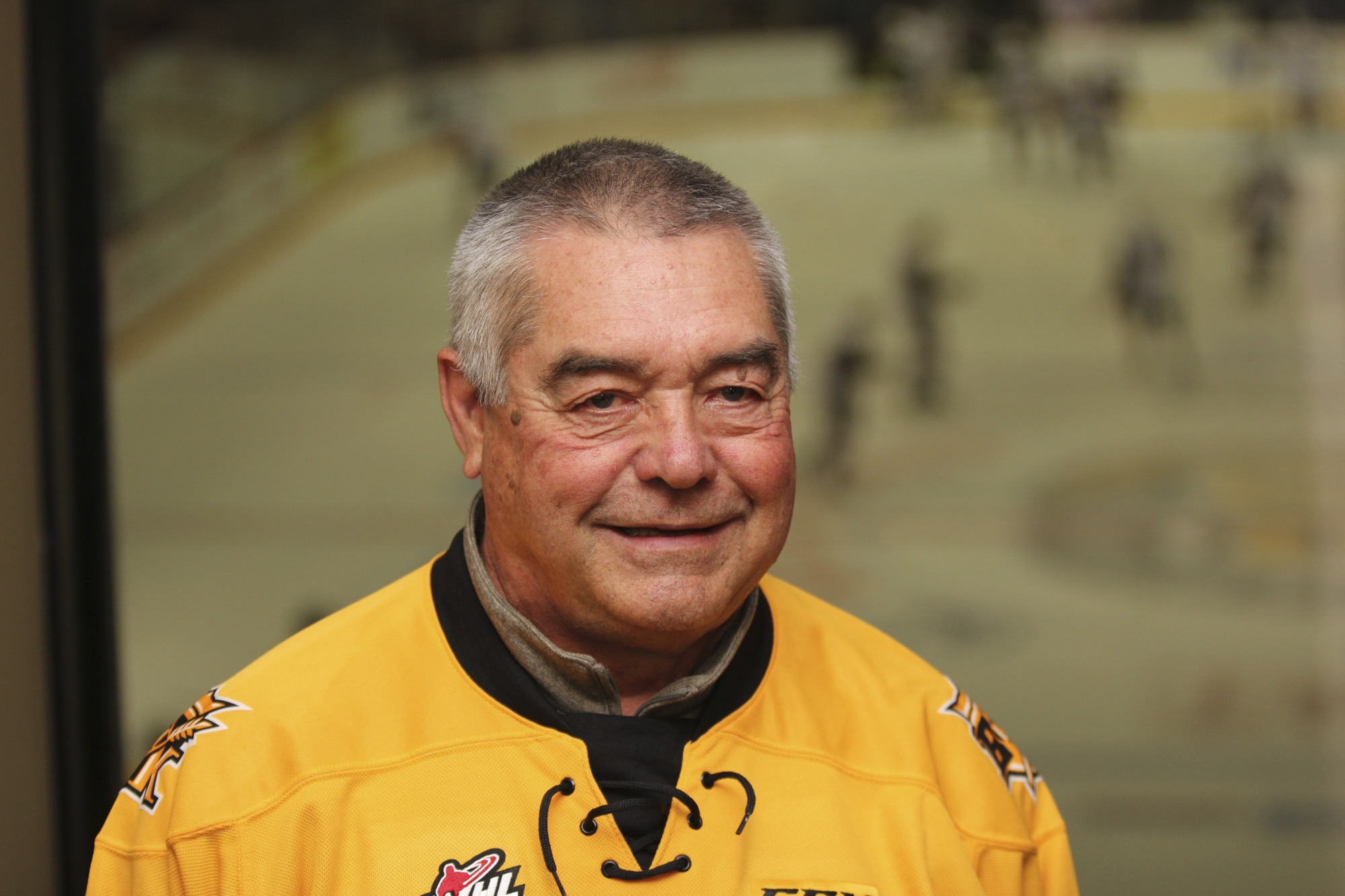
(Courtesy of Perry Bergson, The Brandon Sun) — Ray Brownlee’s ties to the Brandon Wheat Kings go well beyond the four seasons he spent with the club from 1965 to 1969.
Now 66 and the managing partner of Century 21 Westman.com Ltd., Brownlee remembers walking to the Wheat City Arena at the corner of Victoria Avenue and 10th Street, where the Brandon Police Service building now stands, from his home on Third Street East as a young boy to see the Wheat Kings.
“Every kid in Brandon did that,” Brownlee said. “We got in for a quarter and sat up in the northeast corner. The old arena had wooden seats around it and in the corners there was a big box affair that about 25 kids could get up on. You were up fairly high from the ice. We could go up there and almost do whatever we wanted. There was typical boys wrestling and fighting and stuff, but we were at a Wheat King game.”
As a result, Brownlee’s cohort of friends, including future Wheat Kings Jack Bortosik, Roy McLachlan, Bruce Bonk and Gerald Canart, had an emotional tie to the team that outsiders never could.
Brownlee called players such as Dunc McCallum, Dennis Hextall and Bob Ash his heroes.
“All of a sudden you’re that kid at 16, 17 and you almost have to pinch yourself,” he said of making the team himself. “It’s like you made the NHL locally.”
He never played midget. The Wheat Kings held an open tryout for their Junior B team in the South West League, and he and a couple of his buddies from the Central Community Centre saw it as a chance to get some free ice time.
At age 14 and weighing about 135 pounds, Brownlee earned a spot on the team that opened the new rink in Deloraine.
“There were a lot of discussions, I learned years later, behind the scenes with my parents about getting hurt and all that stuff,” he said. “But it happened.”
A personal highlight that season came when he was called up to the Wheat Kings for one game around Christmas. Although he only had a handful of shifts, he banked the puck in off an opposing defenceman’s skate with a shot from behind the net and scored.
A year later, in the 1965-66 season, he earned a full-time spot with the Wheat Kings at age 15, giving him a chance to play with a pair of Wheat King legends, Bill Fairbairn and Juha Widing.
He remembers Fairbairn as the team’s quiet leader whose toughness and determination to win rubbed off on everyone else.
Widing was different. Brownlee said he had never witnessed talent like that possessed by “Swede,” the nickname for the forward who was born in Finland but grew up in Sweden.
“He was a skater like you’ve never seen before,” Brownlee said. “He just glided on skates. He was so far ahead of all of us in skating ability in the whole league. Not only could he skate and handle the puck better than all of us, in today’s game he would have been one of the 18-year-olds playing in the NHL.”
Brownlee had plenty of his own talent. In his second season, at age 16, he had 47 goals and 38 assists in the Manitoba Junior Hockey League.
“I was a goal scorer, that was my probably my forte,” Brownlee said. “I certainly wasn’t physically strong.”
As a result, he had to rely on his smarts, even though he usually played with Brandonite Bobby Young and centre Jack Wells, bigger guys who were able to protect him.
In Brownlee’s third season, 1967-68, the Wheat Kings joined a new loop called the Western Canada Junior Hockey League, which would rename itself the Western Hockey League in 1978. In 58 games, he had 37 goals and 33 assists.
Going into his 18-year-old season in 1968-69, a bout of hepatitis limited him to 30 games. After four years with the Wheat Kings he figured he had enough, so he chose to go to Brandon University in 1969-70 to play with the Bobcats as a 19-year-old.
“I didn’t see myself as being in the NHL or playing pro hockey,” he said. “To be very honest, it wasn’t a big goal of mine. I don’t think that I loved the game enough.”
His real passion was flying, and he dreamed of being an airline pilot, but discovered at age 16 that he was colour blind, disqualifying him from the job. During his time at BU playing with the Bobcats, he earned a bachelor of teaching degree in 1970, but life would soon take him a very different direction.
The Boston Bruins drafted him in the third round that spring. He had married his sweetheart Cindy the previous November in 1969, so suddenly pro hockey could pay the bills.
It would provide him with a five-year adventure in the North American minors, although he never forgot home.
“When I played for the Wheat Kings and made the Wheat Kings in that first year, skating out onto the ice in that old Wheat City Arena, that was more exciting to me than my first training camp and playing a few exhibition games in training camps against the Leafs and St. Louis and some of these teams,” he said.
He spent two years in the Boston organization, had one as a free agent when he won the International Hockey League’s Turner Cup with the Fort Wayne Komets, and then signed with St. Louis.
In 1973-74, he ended up with the Denver Spurs, where he was reunited with his Brandon buddy Jack Borotsik. On a bad team, they took pride in their aggressive penalty-killing ability. That season ended in December for Brownlee when he snapped his wrist and was told he would never play again.
After surgery the next day, which was successful enough that he only lost 25 per cent of his wrist’s mobility, he was able to return for the next season.
Within a couple of weeks, Borotsik broke his leg and was also gone.
Brownlee went back for one final season, but the wrist surgery meant he had lost much of his shot’s velocity so he knew it was a time to say goodbye to hockey.
“I didn’t want to play in the minors for another four or five or six years and then be looking for work,” he said. “I don’t want to bounce my family around the minors. I just assessed my own talent and said I’m not going to play in the NHL because I’m not strong enough and don’t have the hot button to do it. So we came back to Brandon.
“It was never really my hobby, my passion. I watched guys with, I think, a lot less talent than me do much better because they just had the drive and the will and the passion. I don’t apologize for that; I really enjoyed hockey and what hockey gave me and the experiences and the travelling … I never regretted the road I took but I never missed it when I left.”
Brownlee found his calling in real estate instead. He had earned his real estate license in 1973, and between hockey seasons realized he liked it.
He started in the business with Douglas Rungay in 1973, and went on to buy the Century 21 franchise in 1980 with Don Hawking. They purchased their current building on 10th Street in 1982 and Brownlee became managing partner in 1996.
Brownlee and wife Cindy have two daughters, Kristi and Becky, and a four-year-old granddaughter.
He was touched that the Wheat Kings honoured members of that first WHL team at the ceremonial puck drop at their home opener this season, saying the team has no idea how much it meant to the former players.
“To be able to come back at our age and have those memories revisited and acknowledged, was really, really special,” he said. “That night will be something that I’ll never forget.”
He said it’s made him stop and think about the significance of what came before in his career and Wheat King history. It’s a great honour for the little boy who walked 13 blocks down Victoria Avenue to games to be considered one of the franchise’s WHL forefathers.
“It’s a privilege and pride and an honour that we were the start of it all,” Brownlee said. “Nobody knows the future and certainly nobody envisioned this back in 1967-68. It’s kind of cool to be able to say that we played the first game of day one in the Western Hockey League as a Wheat King.”