




























































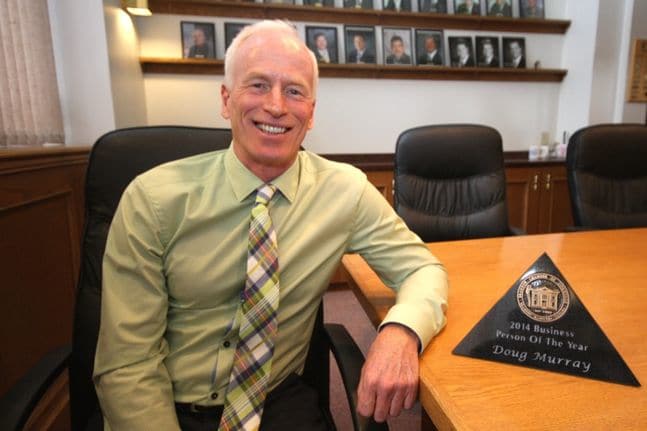
ALUMNI SPOTLIGHT: BRANDON BUSINESSMEN DOUG MURRAY
(Courtesy of Perry Bergson, Brandon Sun) — When Doug Murray talks about the bad breaks he suffered as a Brandon Wheat King, he means it literally.
Now 62, Murray spent parts of four seasons with what was then a Western Canadian Hockey League team. While his fine play led to his selection in the National Hockey League draft, it was broken legs in his 17-year-old and overage seasons that in some ways define his time in the league.
“Really my career, unfortunately, was about missed opportunities,” Murray said.
He first skated when he was four years old on the frozen Souris River. After moving to Brandon at age five, he would walk a block from his house to the Park Community Centre. He worked his way up through the Brandon minor hockey system, attending plenty of Wheat King games as a youngster.
“You always wanted to be the best that you could be,” he said. “I always seemed to have success playing hockey, so I guess that I hoped that I would keep progressing and it just seemed natural that I would hopefully make the Wheat Kings one day. I was always a little bit surprised if I got scouted for U.S. college, I was always just kind of surprised that they thought I was a good hockey player. You kind of gain confidence after a while.”
Murray skated with the Wheat Kings for the occasional practice in his 16-year-old season, but he earned a full-time spot as a 17-year-old in the 1972-73 season.
Murray admitted that he didn’t care for the rough and tumble era of the game that took hold in the 1970s.
“All the fighting was something that I really had to get used to,” Murray said. “I believe the sport of hockey now is a much better sport than it was in my era. It just seemed to get lost for a little while. I don’t know if it was the influence of the Philadelphia Flyers, the Broad Street Bullies, or even some of the Western Canadian Hockey League coaches back then who were having success like Paddy Ginnell and Ernie (Punch) McLean. They had a lot of success by having big tough teams that fought all the time after the (Flyers coach) Fred Shero model. The game almost became more about fighting.”
In his first WCHL exhibition game, against the Estevan Bruins, Murray took the puck off the opening faceoff and scored a handful of seconds later.
“I like to say that my career started quickly and went downhill from there,” he said with a chuckle.
He found himself in some fast company when head coach Rudy Pilous put him on a line with two of the great forwards in franchise history, Ron Chipperfield and Rick Blight.
“Rudy’s line was that I went together with them like ham and eggs,” Murray said. “Looking back, I feel sorry for Ron Chipperfield having to play with me. He’s trying to set scoring records, so why not put him with a guy who can pass him the puck or put his passes into the net a little better than I could.”
Unfortunately for Murray, the dream spot in the lineup wouldn’t last. On Nov. 10, 1972, just 13 games into his rookie system, Murray caught a crack in the ice during a game in Saskatoon and broke his leg. He would miss the rest of the season, and suited up for the Brandon Travellers in the Manitoba Junior Hockey League for two-thirds of the 1973-74 season as he worked to regain strength in the leg after several months in a cast.
Murray returned to the Wheat Kings for the final 15 games of the 1973-74 campaign before having a breakout year the following season when he was 19.
It started with a move to some fancy new digs.
Murray grew up playing in the Wheat City Arena — ”I loved it, it just had a certain smell and feel to it” — but started his junior career in the Manex Arena as the Keystone Centre was being constructed. He was on the ice when the team opened its 1974-75 season in the new facility.
“It was fantastic,” Murray said. “I had two goals and some assists and we won 13-1 against the Winnipeg Clubs. The place was just packed and we weren’t used to playing in front of packed houses back then. It was a new arena and just full. After that it sort of went back to crowds of about 2,000 or so, but that was a special night.”
Murray said it was a treat skating in the new building, adding it made the players feel like professionals.
He played all 70 games that season, scoring 18 goals and adding 23 assists to go with his 161 penalty minutes. Murray caught the eye of the Vancouver Canucks, who picked him in the fifth round, 82nd overall, of the 1975 NHL draft. (The draft was then for 19-year-old players.)
“I never thought I would make it as a hockey player,” Murray said. “It was a surprise to me that I got drafted and it really helped me with my confidence. Once I got drafted I thought maybe I can make it.”
In his overage season, Murray went to Canucks camp and played four games with the Tulsa Oilers of the old Central Hockey League, scoring once. When they wanted to send him down to a lower pro league, Murray opted to rejoin the Wheat Kings instead.
In his first eight games back in Brandon, he scored twice and added five assists, and looked to be taking his play to another level.
It all came crashing down in mid-November of 1975 when he broke his other leg during the final minute of a game in Winnipeg. He was busting into the Winnipeg end and a defenceman sent him into the goal post in an era when nets were more rigidly pegged into the ice.
He spent several months in a cast and missed the rest of the season.
“It was upsetting,” Murray said. “I really felt like that was the end of my career. I didn’t think that I could come back from that one. I was a marginal player and I needed every kind of break going for me if I was going to make it. It was crushing.”
In total, he played 106 WCHL regular-season games, scoring 26 goals and adding 37 assists to go with 208 penalty minutes. In 45 MJHL games with the Brandon Travellers, Murray scored 23 goals and earned 23 assists.
He would play with the University of Calgary Dinos for the next three years, earning an all-Canadian designation in 1978 after scoring 18 goals and adding 23 assists in just 24 games.
For the Olympic year of 1980 in Lake Placid, N.Y., the Canadian team was being selected from college players, and Murray had caught their eye.
But he suffered a broken ankle playing soccer in 1978, and wasn’t able to compete for a spot.
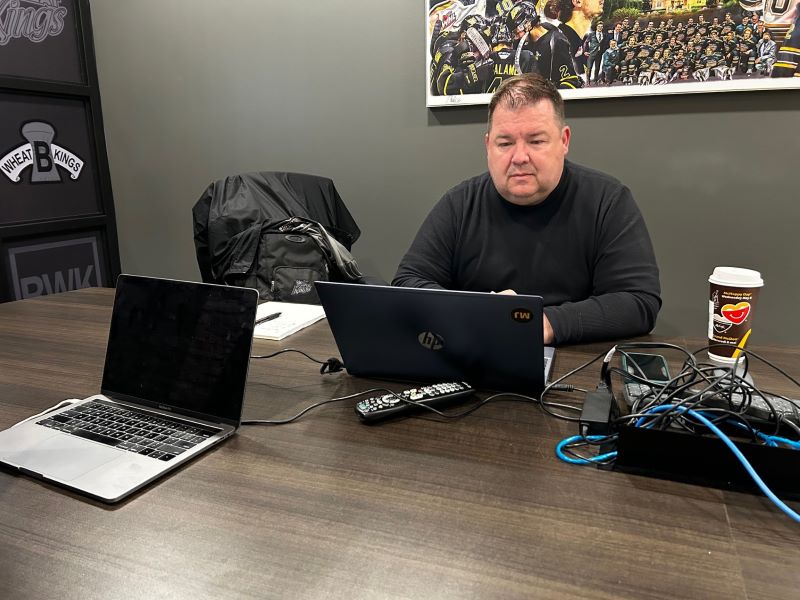
After one final season in Calgary, he returned to Brandon and entered the family car business, which is now called the Murray Auto Group. Murray currently serves as chief executive officer of the chain of dealerships, with a big bed for his Labrador retriever, Ben, in the corner of his office.
Murray’s grandfather Andy opened the original dealership in Souris in 1926, with sons Ewart and Clair joining the business and Del running the farm dealership. (Del passed away at age 90 on Oct. 19.)
All four of Clair’s sons — Doug, Dan, Chris and Paul — have important roles in the company. (Longtime hockey coach Andy Murray is Doug’s cousin.)
“I really don’t look back at those years as the best years of my life,” Murray said of his junior hockey days. “I kind of like all the years really. The years right now are really good too. I find the car business, being on a sales team and trying to reach sales goals and fighting through adversity and doing difficult things and competing with other people, I really find this business that I’m in to be a lot like hockey. I’ve got a bachelor of commerce degree from the University of Calgary but I really think that my years playing hockey probably taught me more for this business than even my formal education.”
He married his wife Laurie in 1981, and they have two daughters, Lyndsay, a married lawyer in Winnipeg who has a little girl named Millie, and Megan.
In a strange twist of fate, Murray’s son-in-law was able to enjoy the NHL career that he had once hoped for.
Megan married Mason Raymond, who was also drafted by the Canucks and would go on to play 546 NHL games. He now skates with SC Bern in the top tier of the Swiss hockey league system.
The couple have a five-year-old son, Max, and a two-year-old daughter, Grace.
Oddly, Raymond may have the shot at the Olympic team that Murray missed out on.
“Mason has done all the things that I tried to do but didn’t quite accomplish,” Murray said.
Murray is an avid flier, piloting his plane to the family cabin in Invermere, B.C., and has participated in the Riding Mountain Triathlon in the past with his brother Dan.
He doesn’t miss his hockey days, and certainly doesn’t pine for the lost opportunities, but is instead thankful for the impact the game had on him.
“My dad always had a saying that everything works out for the better,” Murray said. “I just had to believe that. You want to do the best you can at whatever you do.”
Murray’s old club returns to the ice Sunday afternoon when Swift Current invades Westman Place.