

























































ALUMNI SPOTLIGHT: JEFF ODGERS
(Courtesy of Perry Bergson, Brandon Sun) — Jeff Odgers isn’t shy about expressing his affection for the four years he spent as a Brandon Wheat King.
“I absolutely loved my time there,” Odgers said. “Just strictly as a hockey experience, I’m pretty realistic. When I came into the league, the Brandon Wheat Kings were probably one of the few teams that I would have made as a 17-year-old with my skating so I’m thankful for the group of guys that we had and my billet family and the people that I met.”
Now 48, he went on to play 821 regular-season games and 47 playoff games in the National Hockey League.
Odgers grew up on a farm near Spy Hill, Sask., where his parents Fred and Cheryl and grandparents John and Mabel were farming a mixed cow-calf and grain operation.
“I always loved farming,” Odgers said. “I knew that no matter what I did, I always wanted to farm and cattle would always be a part of it. And luckily enough, after I finished hockey, I was able to come back and farm.”
Spy Hill, which is just across the Saskatchewan border southwest of Russell, is a 200-km drive from Brandon.
He played hockey and baseball growing up, in part because his school wasn’t big enough to have volleyball or basketball teams.
Odgers learned to skate on a dugout, and his dad later built a rink in the backyard. Since the family was only two miles from town, a busy community of 300 at the time that is now closer to 200, he also was able to skate at the rink.
“There was always access to ice, whether it was on the farm or in town,” he said.
There were enough kids some years to make a team in Spy Hill. In other seasons, he would head to nearby towns like Langenburg or Rocanville.
After getting cut by the Yorkton Harvest as 15-year-old trying to play AAA midget hockey and spending the winter in Rocanville playing AA instead, he followed his good friend Kevin Kaminiski of Churchbridge —who would also go to play in the NHL — to the Saskatoon Blazers midget AAA team the next season. Odgers would earn 56 points in 36 games, and was listed by the Wheat Kings, where his Blazer teammate and good friend Kevin Cheveldayoff was also headed.
Odgers said the Western Hockey League had always been on his radar.
“I knew that I wanted to get there but I didn’t know anything about it,” he said. “Where I was growing up, even though Brandon was only two hours away and Regina was three-and-a-half hours away, it seemed like a world away. I had never been to a game and wasn’t really ever exposed to it. I knew that it was something I wanted to get to.”
Odgers would stick in Brandon as a 17-year-old, playing 70 games, scoring 21 points and accumulating 150 penalty minutes in the 1986-87 season.
After the season spent in Saskatoon — where he went from having nine kids in his class to attending a school with more than 1,000 students — the bigger city wasn’t a big transition for the farm kid. But everything else was, especially the level of hockey.
Odgers said he was lucky to share the experience with Cheveldayoff.
“We became very good friends in Saskatoon and he was actually the one who starting telling the Brandon Wheat King scouts about me,” he said.
Odgers said he realized pretty quickly after he arrived in Brandon that his role would have to change.
“When you play AAA midget, not everybody is a goal scorer,’ he said. “Then you go to (Wheat Kings) camp and when you look around, every goal scorer is there. I wasn’t the best skater or fanciest guy so I kind of knew that I had to bring a little something else to help separate myself and hopefully stay there. Being that guy who is a little bit tenacious and willing to drop the gloves and be hard on people was kind of a way to help me make the team.”
Even with the role he had to take on, Odgers’ game improved offensively. As a 17-year-old, he had 35 points in 70 games, and as a 19-year-old, he scored 31 goals and added 29 assists to go with his 277 penalty minutes.
Still, NHL clubs passed him over in the draft both years, even after he was assured by teams that they would take him as a late selection.
“It never happened, and that was the first real time where I sat down and thought maybe this is the end of the line,” Odgers said. “Maybe this is as far as I’m going to be able to go. That summer it was disappointment, especially when I looked around the league and saw guys who were playing that I had more goals and had more penalty minutes and thought I did a lot more and never ever got drafted.”
He would get the last laugh, ultimately playing more regular-season games in the NHL than all but 15 of the 252 drafted players in 1989.
In his overage season in Brandon, Odgers played 64 games, tallying 37 goals, earning 28 assists and taking 207 penalty minutes to finish third in scoring behind the guys he played with every night, Cam Brown and Brian Purdy.
Odgers said he stayed close to a number of guys on that team, which missed the playoffs in his final two seasons.
He chuckles when asked about the time the team bus ran out of gas. After a miscalculation on how much fuel was needed, the bus ended up stranded by the highway west of Brandon in the middle of a bitterly cold night as it returned from Prince Albert, Sask.
“We just had to sit on the bus, and as you know, when a diesel runs out of fuel, you can’t just fire it up,” he said. “You need a mechanic out there to prime it up and get it going. It was just another day in the life of a Brandon Wheat King.”
A nice part of playing in the Wheat City was that his parents were able to drive out for games after harvest ended. It was a nice change for the oldest of four kids because they hadn’t been able to make the longer drive to Saskatoon very often.
The Minnesota North Stars invited him to their summer camp after the draft, but didn’t offer him a contract. Instead, he signed with the expansion San Jose Sharks after his junior career ended.
Odgers would graduate to the International Hockey League for the 1990-91 season, piling up 318 penalty minutes in 77 games as his Kansas City Blades won the IHL title.
Aside from playing against men, he quickly learned one of the biggest differences between junior and pro hockey.
“When we played junior, we did everything together as a team,” he said. “Tuesday night was movie night for the whole team. The older guys, we would meet every morning for breakfast before practice. Those guys on your team, you spent more time with them than anyone. You developed a special bond that comes with time. As you move on to pro, guys have wives and families and other things going on. It’s funny, you have money to do things, where we didn’t, but we just would spend time watching movies or hanging out.”
After starting the 1991-92 season with the Blades, Odgers was called up by the Sharks in their expansion season. A year later he was an alternate captain, and in the 1994-95 season was made captain.
“It was a great opportunity, and when I look back on it, the timing for me to play pro was perfect,” Odgers said. “Expansion was coming in and the style of the game then really warranted a guy like myself. There were at least two guys on every team who played the way I did.”
Odgers, who would earn 145 points in 821 games, would wear a letter in nine of his 12 seasons in the league, also playing with the Boston Bruins, Colorado Avalanche and Atlanta Thrashers.
“I like to think that they could see how much I loved the game and I loved the team and would do absolutely anything for any one of my teammates, whether it be on the ice or off the ice,” Odgers said. “Especially on the ice. I took pride in looking after my teammates and the jersey that I wore.”
He said one of his proudest moments was being named captain of the Sharks because it was voted on by his teammates.
If there is a defining characteristic of his career, it had to be his ability to squeeze every drop of talent out of his body with an unwavering work ethic.
“I wanted to play hockey,” Odgers said. “I loved hockey and I would have done whatever it took and anything to make it. I just wanted to play. I remember that when I was growing up, everything we did was hard on the farm. It was hard work. I remember leaving the farm and going to play hockey and thinking this was easy. All I have to do is work as hard as I can for two hours a day. That’s a piece of cake. When you’re on the farm, your day starts at 6 and ends at dark.”
Odgers, who fought 242 times in the NHL regular season, admits that it wasn’t an easy way to make a living. At six-feet and 200 pounds, he was undersized and knew that if he made a mistake he was going to get hurt.
“Each time I felt really strongly that I did something that I needed to do to stay in the NHL and something that I wanted to do as a teammate,” Odgers said. “I found ways. Anxiety was one of the toughest things. There was a fine line between being able to play and yet always be ready to defend yourself.”
Even so, it was hard to walk away after the 2002-03 season. His boys Dakota and John were getting older, and he knew he would likely have to move from Atlanta to extend his career. With the farm he bought near Spy Hill, it was time to go home.
“It kind of felt like it was the right time to do it,” he said. “It was extremely hard because I felt like I probably could have played a year or two more but it just seemed like the right thing to do at the time for me and my family.”
After four years on the farm, he returned to Atlanta for two years to work as a colour commentator on Thrashers broadcasts before heading back to what’s now a fifth-generation farm for good. He was also part of the Shaw broadcasts of WHL games that ended after last season.
Odgers quit playing senior hockey at age 45 and had a hip replacement a year ago, but is otherwise healthy, saying he can spend a full day out on the farm doing manual labour easily.
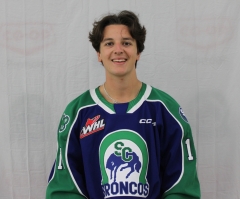
His son Dakota spent five seasons in the WHL with the Swift Current Broncos.
Life on the farm and in the NHL may seem like very different worlds to outsiders, but it makes perfect sense to Odgers, who noted that some players don’t have anything to pour their energy into after they leave the game.
“I’ve been able to do something that I’ve had a passion for my whole life,” he said. “As much as I wanted to play hockey, I wanted to farm. I loved farming and every morning when I get up, I’m excited to do what I do on the farm.”