























































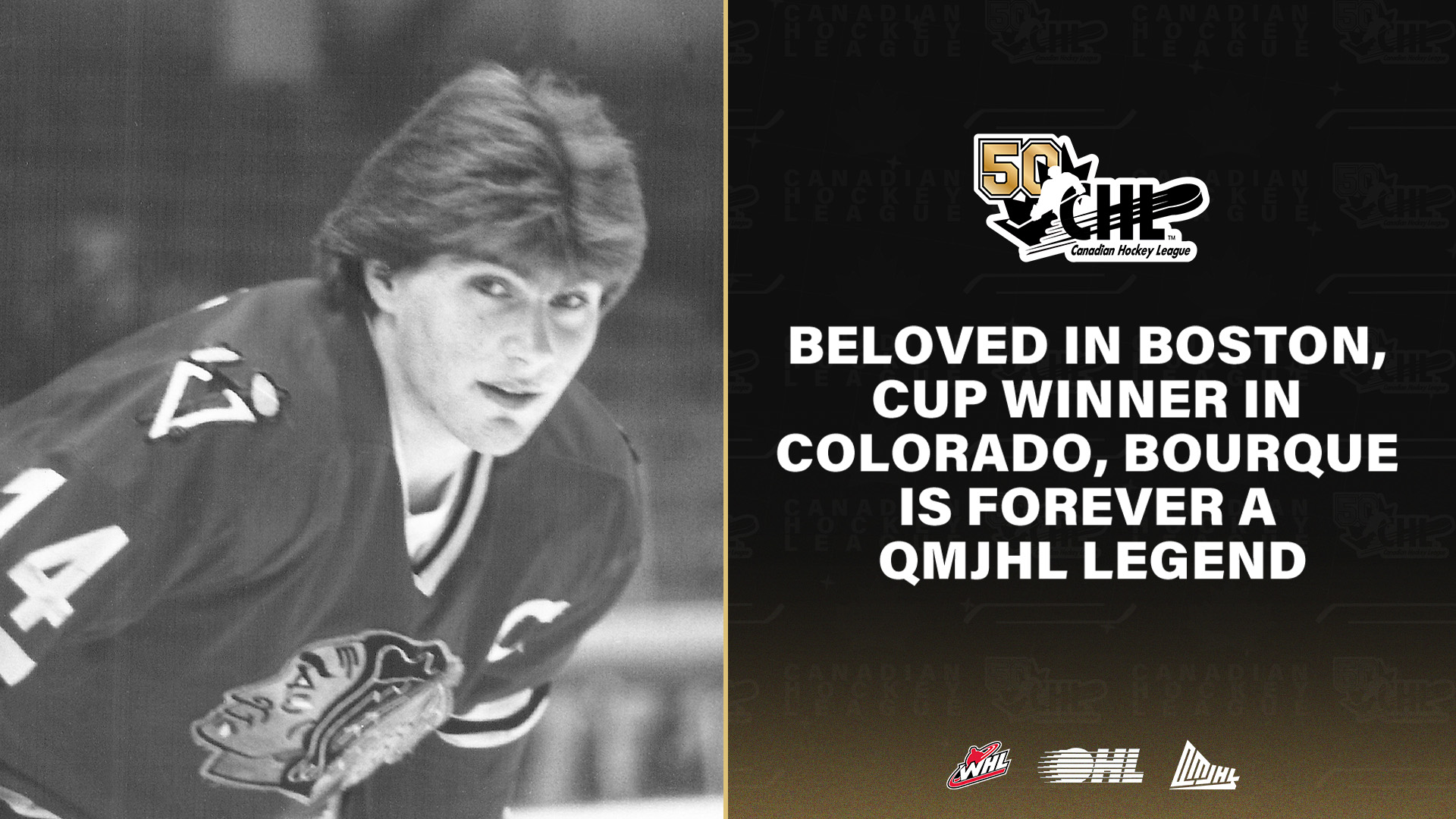
Bourque’s legendary career spans QMJHL as well as Boston and Colorado
By Will MacLaren
Ray Bourque ranks no. 9 on the CHL’s Top 50 Players of the Last 50 Years
Hall of Fame defenseman Brad Park was once asked his thoughts on yet another blueliner who starred with the Boston Bruins. His answer was both definitive and prophetic. “There’s guys in the NHL as big, as strong, who can skate as fast, and shoot as hard,” Park told The Hockey News. “But they just can’t think as fast as a guy like Ray Bourque.”
For context, Park’s remarks were published during the twilight of Bourque’s illustrious career. He said this in the Spring of 1980, when Borque was still a teenager. It was the beginning of a legendary career that would end, over two decades later, with one of the game’s most iconic moments.
Before he got to Boston as the club’s seventh overall selection at the 1979 NHL Entry Draft, Bourque was a leader, on and off the ice, in the QMJHL. In a four-year stint that included time in Trois-Rivieres, Sorel and Verdun, Bourque was a not only a model of consistency but a notable two-way blueliner in an era where most felt defense was a foreign concept in the ‘Q’. Bourque busted those myths, posting 220 points in 204 regular season games while also taking home the league’s Defenseman of the Year award in his final junior campaign. A two-time QMJHL All-Star, Bourque was also named captain of the Verdun Eperviers in his draft year, setting a precedent that would carry forward into his pro career.
For two decades, Bourque was the face of the Bruins and one of the top performers in the NHL. The accolades speak for themselves; the 1980 Calder Trophy as NHL Rookie of the Year, five Norris Trophies as top defenseman, 13 first and six second team All-Star nods and a remarkable 19 consecutive All-Star Game appearances. Bourque would also be named a finalist for the Hart Trophy as league MVP on two occasions, a true rarity as a blueliner. The captaincy he earned in Verdun followed him to Beantown as well; he would wear the ‘C’ for the Bruins for 15 seasons. By the time his career wound down in 2001, he was the NHL’s all-time leader in goals and points and his ticket to the Hall of Fame was just waiting to be punched. There was only one thing left to check off his list.
In 2000, Bourque, who had come up empty handed in two previous Stanley Cup Final appearances, was traded to the Colorado Avalanche. The intent was clear – Cup or bust. In 2001, it ended up being the former after a dramatic seven game triumph over New Jersey. The final stop for Bourque came with his call to the Hall in 2005. To this day, he remains beloved in Boston as a prominent figure in QMJHL history.